Coconut charcoal shapes are often the first thing buyers notice, but shape alone does not determine briquette quality. Technical factors such as moisture, ash content, fixed carbon, and volatile matter also influence how charcoal lights, burns, and produces heat.
Volatile matter in coconut charcoal briquettes refers to compounds released as gas or vapor when charcoal is heated under controlled conditions. For buyers of coconut charcoal for hookah, this value is important because it can affect smoke, odor, ignition behavior, and heat stability during use.
Contents
- Comparing Coconut Charcoal Shapes
- What Is Cube Charcoal?
- Advantages of Cube Charcoal
- What Is Flat Charcoal?
- Advantages of Flat Charcoal
- What Is Hexagonal Charcoal?
- Advantages of Hexagonal Charcoal
- Which Shape Produces Better Heat?
- Important Quality Factors
- Which Charcoal Shape Is Better?
- FAQ Coconut Charcoal Shapes
- 1. Which charcoal shape is best for beginners?
- 2. Does charcoal shape affect burn time?
- 3. Is flat charcoal better for quick sessions?
- 4. Can hexagonal charcoal be used for hookah?
- 5. What matters more: shape or quality?
Comparing Coconut Charcoal Shapes
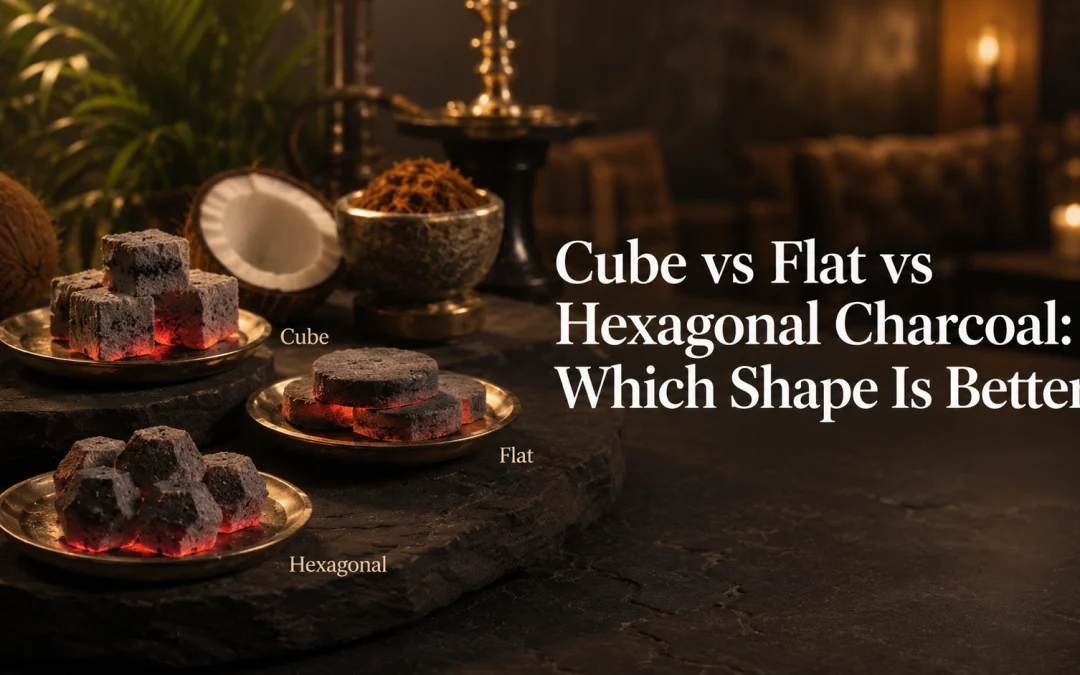
Cube charcoal is widely used for hookah because it delivers stable heat and fits many common bowl setups. Flat charcoal has a thinner profile that allows quicker lighting and easier heat adjustments. Hexagonal charcoal usually offers a longer shape and is commonly selected for extended burning or broader applications.
Here is a simple comparison:
| Charcoal shape | Heat output | Heat control | Typical use |
|---|---|---|---|
| Cube | Stable and balanced | Easy to manage | Hookah and shisha |
| Flat | Moderate and responsive | Highly flexible | Smaller bowls and shorter sessions |
| Hexagonal | Strong and long-lasting | Requires careful placement | Long sessions and multipurpose use |
Actual performance may vary depending on briquette density, moisture content, raw materials, airflow, and production consistency.
What Is Cube Charcoal?
Cube charcoal is formed into equal-sized blocks, commonly available in sizes such as 22mm, 25mm, and 26mm. Its symmetrical shape helps provide consistent heat from different sides when the cube is properly lit and rotated.
This shape is popular for coconut charcoal for hookah because it works with foil setups, standard bowls, and many heat management devices. Users can also add or remove individual cubes to adjust the heat during a session.
Advantages of Cube Charcoal
Cube charcoal provides a balanced combination of heat retention, burning duration, and ease of use. Its compact shape also makes it relatively easy to arrange around the edge or center of a hookah bowl.
For wholesalers, cube charcoal is familiar to many retail customers. It is therefore a practical option for distributors and private-label brands entering the hookah charcoal market.
What Is Flat Charcoal?
Flat charcoal has a thinner and wider profile than a standard cube. Because it contains less material in its vertical dimension, it generally heats through more quickly and responds faster to changes in airflow.
The flat shape can be useful for smaller bowls or sessions that do not require intense, long-lasting heat. Users can reposition the pieces easily to control which parts of the tobacco receive more heat.
Advantages of Flat Charcoal
Flat charcoal is suitable for customers who prioritize quick preparation and flexible heat management. Its lower profile may also fit comfortably inside certain heat management devices.
However, flat pieces may need to be replaced sooner than larger cubes made with the same charcoal formula. Buyers should test the product to determine whether its burning duration matches local customer expectations.
What Is Hexagonal Charcoal?
Hexagonal charcoal is usually produced in an elongated shape with six sides. Some products include a hole through the center to improve airflow and support more even burning.
This charcoal shape is commonly used for longer heating applications. Depending on its dimensions and formula, hexagonal charcoal may provide sustained heat and require fewer replacements during use.
Advantages of Hexagonal Charcoal
The elongated design can offer a longer burning duration than smaller flat or cube pieces. Hexagonal briquettes may also be broken into shorter sections when a user needs less heat.
However, this shape is not always the most practical option for standard hookah bowls. Large pieces may be harder to position, and their heat output can be excessive for smaller setups. Importers should confirm the intended application before selecting hexagonal charcoal.
Which Shape Produces Better Heat?
Cube charcoal generally offers the most balanced heat for hookah use. Its dimensions make it easier to arrange several pieces while maintaining control over the bowl temperature.
Flat charcoal provides more responsive heat because the thinner pieces can be moved or removed quickly. Hexagonal charcoal may retain heat longer, but users need enough space to position it safely.
Charcoal shape should not be evaluated separately from product quality. Well-manufactured hookah charcoal cubes may deliver cleaner and more stable heat than low-density briquettes in a larger shape.
Important Quality Factors
The best charcoal must provide more than an attractive and uniform shape. Wholesale buyers should also evaluate:
- Briquette density
- Moisture level
- Ash content
- Lighting consistency
- Heat stability
- Odor during ignition
- Resistance to cracking
- Uniform dimensions
- Packaging strength
- Batch-to-batch consistency
Samples should be tested using the same burner, bowl, tobacco, and airflow conditions. This helps buyers determine whether performance differences come from the shape or from the overall charcoal quality.
Which Charcoal Shape Is Better?
Cube charcoal is generally the best all-round option for hookah and shisha because it offers stable heat, broad compatibility, and familiar handling. Flat charcoal is suitable for smaller bowls, quicker preparation, and more flexible heat adjustments. Hexagonal charcoal is better for buyers who need sustained heat or charcoal for broader applications.
Importers should select a shape based on customer habits and intended use rather than appearance alone. Packaging requirements, piece count, product positioning, and heat management preferences should also be considered.
Magnus Java supplies Indonesian coconut charcoal briquettes for international buyers. Through its charcoal wholesale service, buyers can discuss charcoal shape, cube dimensions, packaging, branding, and private-label requirements.
Visit Magnus Java to find a coconut charcoal specification that matches your target market and business needs.
And our social media:
Instagram: @Magnusjava
Facebook: @Magnusjava
LinkedIn: @Magnusjava
FAQ Coconut Charcoal Shapes
1. Which charcoal shape is best for beginners?
Cube charcoal is usually the best choice for beginners because it provides stable heat and is easy to manage during a session.
2. Does charcoal shape affect burn time?
Yes, shape can influence burn duration. Larger or denser shapes like cubes and hexagonal briquettes typically last longer than thinner flat pieces.
3. Is flat charcoal better for quick sessions?
Flat charcoal is suitable for shorter sessions because it heats up faster and allows more flexible heat control.
4. Can hexagonal charcoal be used for hookah?
Yes, but it may not be ideal for all setups. Its size and heat output can be too strong for smaller bowls.
5. What matters more: shape or quality?
Quality is more important than shape. Factors like density, moisture, and ash content have a greater impact on performance.