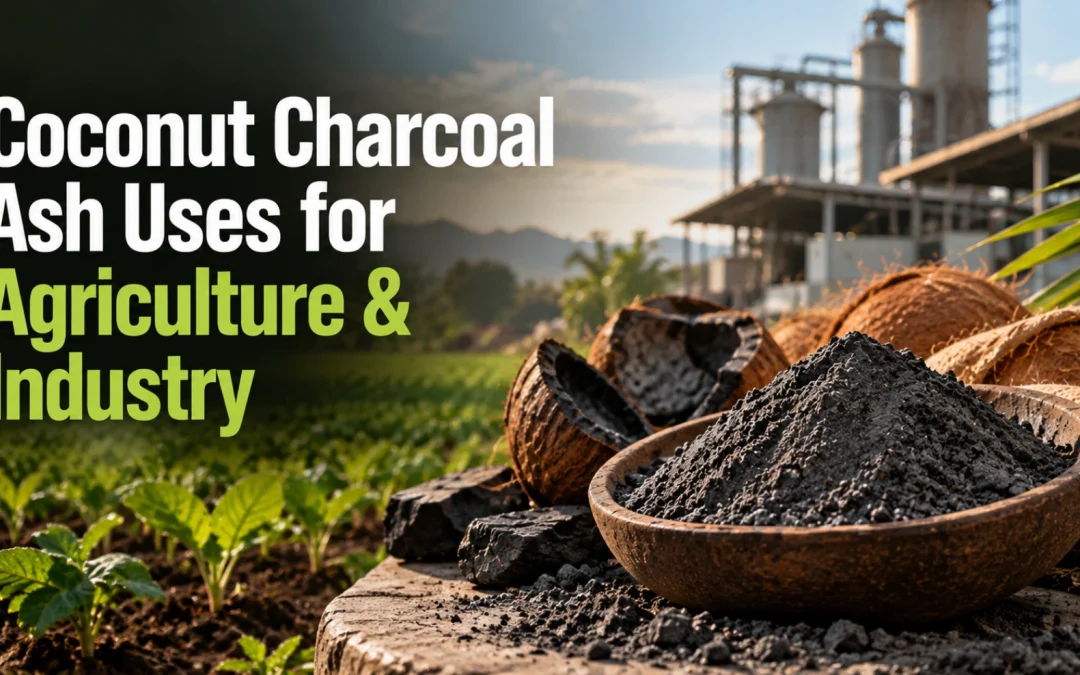
Coconut charcoal ash uses are becoming increasingly relevant as industries look for ways to utilize coconut-derived materials beyond their primary applications. Coconut charcoal ash is the mineral residue left after coconut shell charcoal or other coconut biomass is burned under controlled conditions. Depending on its source and production process, the ash can contain minerals such as potassium, calcium, magnesium, sodium, and other inorganic compounds.
For importers, distributors, and trading companies in Europe, the Middle East, and North America, understanding coconut charcoal ash uses can help identify potential applications for this coconut-derived material. Its properties make it relevant to agriculture, soil management, fertilizer formulations, and selected industrial applications, although its suitability should always be evaluated through chemical and quality testing.
Contents
- What Is Coconut Charcoal Ash?
- What Are the Main Coconut Charcoal Ash Uses?
- 1. Soil Amendment
- 2. Potassium Source for Agriculture
- 3. Ingredient in Fertilizer and Soil Products
- 4. Supporting Circular Agriculture
- 5. Industrial Material Applications
- Factors That Affect Coconut Charcoal Ash Uses
- Raw Material
- Combustion Conditions
- Mineral Composition
- pH and Alkalinity
- Contaminant Levels
- Coconut Charcoal Ash vs. Coconut Charcoal
- What Should International Buyers Check?
- Why Consider Coconut-Derived Materials from Indonesia?
- FAQ
- 1. What are the main coconut charcoal ash uses?
- 2. Is coconut charcoal ash good for plants?
- 3. Can coconut charcoal ash be used as fertilizer?
- 4. What is the difference between coconut charcoal and coconut charcoal ash?
- 5. What should importers check before buying coconut charcoal ash?
What Is Coconut Charcoal Ash?
Coconut charcoal ash is the fine mineral residue generated after coconut shell charcoal or coconut-based biomass undergoes combustion. Unlike charcoal, which contains a significant amount of carbon, ash is primarily composed of inorganic minerals that remain after the combustible components have been burned. The exact composition of coconut charcoal ash can vary depending on several factors, including the type of coconut material used, combustion temperature, oxygen availability, processing conditions, and contamination during production.
Research examining coconut shell-derived materials has identified minerals including potassium, calcium, sodium, zinc, and iron in the resulting ash. This mineral composition is one reason coconut ash has attracted attention for agricultural and industrial applications. Coconut charcoal ash should therefore not be treated as a standardized fertilizer automatically. Buyers need to evaluate parameters such as moisture, ash content, pH, potassium concentration, calcium, magnesium, particle size, and potential contaminants before selecting the material for a particular application.
What Are the Main Coconut Charcoal Ash Uses?
The potential applications of coconut charcoal ash are closely connected to its mineral composition and alkaline characteristics. Some of the most relevant coconut charcoal ash uses include agriculture, soil amendment, fertilizer formulations, and selected industrial applications.
1. Soil Amendment
One of the most recognized coconut charcoal ash uses is as a soil amendment. Coconut-derived ash can contain alkaline mineral compounds that may influence soil pH. Research on coconut husk ash has shown that its application can increase soil pH, particularly in acidic soils. This makes coconut ash potentially useful in soil management where increasing soil pH is required.
However, the appropriate application rate depends on the existing soil condition. Excessive application of alkaline ash can raise soil pH beyond the range suitable for certain crops. For commercial agricultural applications, buyers should therefore consider soil testing before determining how coconut ash should be applied.
2. Potassium Source for Agriculture
Another important application is using coconut ash as a source of potassium. Potassium is an essential plant nutrient involved in several physiological processes, including water regulation, nutrient transport, and plant development. Studies on coconut husk ash have demonstrated its potential to supply potassium to soil.
A study indexed by FAO AGRIS found that coconut husk ash provided potassium and improved soil conditions in coconut plantations. The research also reported that coconut husk ash performed comparably to potassium chloride under the conditions tested, although the researchers noted that ash would not completely replace conventional potassium fertilizer. This makes potassium content an important quality parameter when evaluating coconut charcoal ash for agricultural markets.
3. Ingredient in Fertilizer and Soil Products
Coconut charcoal ash uses can also extend to fertilizer and soil amendment formulations. Because coconut ash can provide potassium and other mineral elements, it may be incorporated into certain fertilizer blends or used alongside other organic and mineral amendments. Research published through FAO AGRIS has also investigated coconut husk ash as a fertilizer, soil amendment, and material that can be combined with compost.
For fertilizer manufacturers, however, the ash should be evaluated based on its actual nutrient profile rather than its origin alone. Consistent chemical specifications are important when developing a commercial formulation.
4. Supporting Circular Agriculture
Another potential benefit of coconut charcoal ash is its role in circular utilization of coconut biomass. Coconut processing generates several by-products, including husks and shells. Instead of treating these materials only as waste, they can be processed into commercially useful products such as coconut fiber, cocopeat, coconut shell charcoal, and, under appropriate conditions, ash.
Using the resulting ash in agricultural applications can help return certain mineral nutrients to soil. This approach can support more efficient utilization of coconut biomass while creating additional value from processing residues.
5. Industrial Material Applications
Coconut shell ash has also been investigated for industrial applications, particularly in construction materials. Research published in Cleaner Engineering and Technology investigated coconut shell ash as a potential component in concrete. Other research has examined coconut shell ash and other agricultural ashes as supplementary materials in cement-based applications.
These studies demonstrate that coconut-derived ash is not limited to agricultural uses. However, industrial applications require specific physical and chemical characteristics, meaning ash intended for construction should not automatically be considered suitable for agricultural use, or vice versa.
Factors That Affect Coconut Charcoal Ash Uses
Not all coconut charcoal ash has the same characteristics. Several factors can influence which applications are technically appropriate.
Raw Material
Ash produced from coconut shell, coconut husk, or other coconut biomass can have different chemical profiles. Buyers should confirm the original feedstock before evaluating the product.
Combustion Conditions
Burning temperature and combustion conditions can affect the final mineral composition and physical characteristics of the ash. Controlled processing can help produce more consistent material.
Mineral Composition
Potassium, calcium, magnesium, sodium, and other minerals can influence potential applications. Laboratory analysis is important for determining the actual composition of a commercial batch.
pH and Alkalinity
Some coconut-derived ashes are alkaline. This characteristic can be beneficial for certain soil applications but may be unsuitable when a crop requires acidic or neutral growing conditions.
Contaminant Levels
For international buyers, testing for unwanted contaminants is particularly important. Depending on the intended market and application, specifications may include heavy metals, foreign materials, moisture, and other quality parameters.
Coconut Charcoal Ash vs. Coconut Charcoal
Coconut charcoal and coconut charcoal ash are different materials and should not be treated as interchangeable products. Coconut charcoal is a carbon-rich material commonly produced from coconut shells through controlled carbonization. It can be processed into products for applications such as activated carbon or charcoal briquettes.
Coconut charcoal ash, on the other hand, is the mineral residue remaining after combustion. Its higher mineral fraction means its potential applications are more closely associated with soil amendment, nutrient recovery, and selected industrial uses. Understanding this distinction is important for importers and distributors when specifying products, documentation, packaging, and intended end uses.
What Should International Buyers Check?
For importers, distributors, and trading companies sourcing coconut charcoal ash internationally, product specifications should be reviewed before purchasing.
Important parameters may include:
- Ash content and moisture level
- Potassium concentration
- Calcium and magnesium content
- pH value
- Particle size
- Color and physical appearance
- Heavy metal and contaminant levels
- Production and processing method
- Packaging and bulk shipping requirements
- Certificate of analysis and applicable documentation
Requirements can differ between Europe, the Middle East, and North America depending on the intended application and local regulations. Buyers should therefore verify the applicable requirements in their destination market before importing or distributing coconut ash products.
Why Consider Coconut-Derived Materials from Indonesia?
Indonesia is one of the world’s major coconut-producing countries, creating opportunities for international buyers looking for coconut-derived raw materials. The country’s established coconut supply chain supports the production of various coconut-based commodities, including cocofiber, cocopeat, coconut shell charcoal, and other derivatives. For international buyers, working with a supplier capable of handling multiple coconut products can simplify sourcing and provide opportunities for broader product portfolios.
Magnus Java supplies Indonesian coconut-derived products for international markets, supporting buyers looking for coconut-based materials for wholesale and commercial applications. For businesses interested in expanding their coconut-derived product sourcing, explore cocofiber and other products from Magnus Java.
Visit our social media:
Instagram: @Magnusjava
Facebook: @Magnusjava
LinkedIn: @Magnusjava
Follow Magnus Java and discover more about Indonesian coconut charcoal for hookah, shisha, and international wholesale markets.
FAQ
1. What are the main coconut charcoal ash uses?
The main potential coconut charcoal ash uses include soil amendment, potassium supply for agriculture, fertilizer formulations, circular agriculture, and selected industrial applications.
2. Is coconut charcoal ash good for plants?
Coconut-derived ash can provide potassium and other minerals and may increase soil pH. However, its suitability depends on the crop, soil condition, ash composition, and application rate. Soil and product testing should be conducted before use.
3. Can coconut charcoal ash be used as fertilizer?
Coconut ash may be used as a fertilizer ingredient or soil amendment when its nutrient composition and safety parameters meet the requirements of the intended application. It should not automatically be treated as a complete fertilizer.
4. What is the difference between coconut charcoal and coconut charcoal ash?
Coconut charcoal is a carbon-rich material produced through carbonization, while coconut charcoal ash is the mineral residue produced after combustion. Their chemical characteristics and applications are therefore different.
5. What should importers check before buying coconut charcoal ash?
Importers should review the product’s chemical composition, potassium and mineral content, pH, moisture, particle size, contaminant levels, production method, certificate of analysis, packaging, and applicable destination-market requirements.