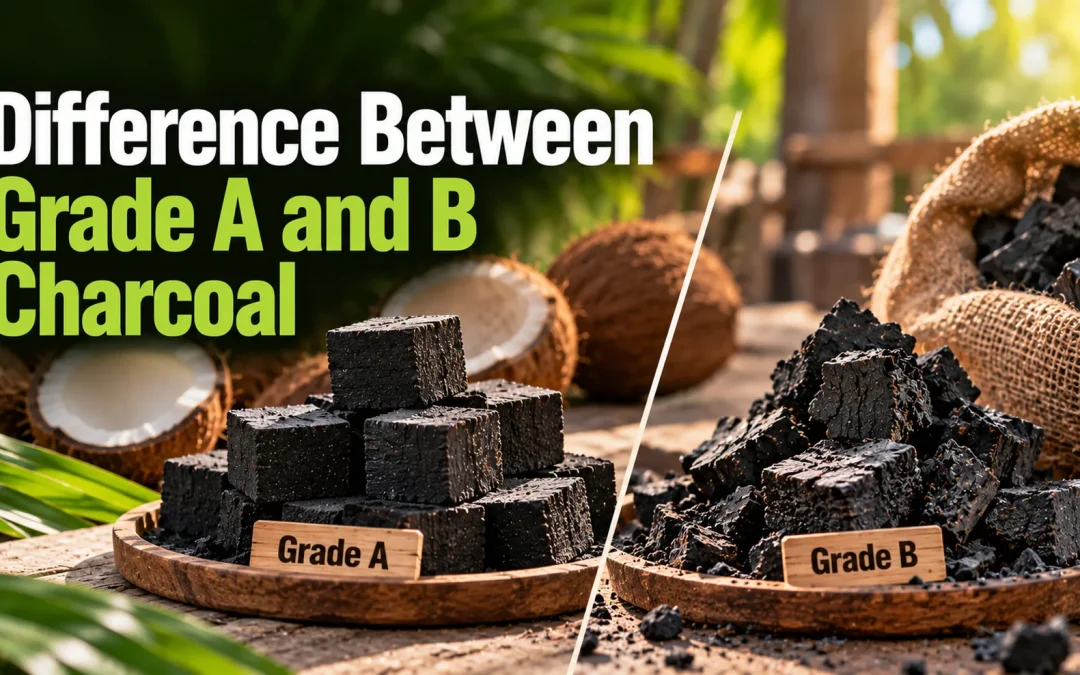
The difference between grade A and B charcoal is mainly related to product quality, ash content, moisture level, carbon composition, and consistency during burning. For importers, distributors, and trading companies purchasing coconut shell charcoal briquettes, understanding these differences is important when selecting products that match customer expectations and market requirements.
Although both grades can be made from coconut shells, Grade A charcoal is generally positioned as a premium option, while Grade B charcoal is often offered as a more economical alternative. However, the exact specifications can vary between manufacturers because Grade A and Grade B are not universal quality classifications with identical requirements across every supplier. Buyers should therefore compare measurable product specifications rather than relying on grade labels alone.
Contents
- What Is Grade A Charcoal?
- What Is Grade B Charcoal?
- Difference Between Grade A and B Charcoal
- 1. Raw Material and Composition
- 2. Ash Content and Ash Color
- 3. Burning Performance
- 4. Moisture Content and Fixed Carbon
- 5. Physical Strength and Appearance
- 6. Price and Commercial Value
- Grade A vs. Grade B Charcoal at a Glance
- Which Charcoal Grade Is Better for Importers and Distributors?
- Why Product Specifications Matter More Than Grade Labels
- Frequently Asked Questions
- 1. Is Grade A charcoal always better than Grade B?
- 2. Does Grade A charcoal always have lower ash content?
- 3. Can Grade B charcoal be made from 100% coconut shells?
- 4. What should importers check before ordering coconut charcoal in bulk?
- 5. Which charcoal grade is suitable for international wholesale markets?
- Explore Coconut Charcoal Products from Magnus Java
What Is Grade A Charcoal?
Grade A charcoal generally refers to premium-quality charcoal briquettes designed to provide consistent burning performance, relatively low ash production, and good structural strength. In the coconut charcoal industry, this grade is commonly associated with products made from coconut shell charcoal for hookah and shisha applications. Premium coconut charcoal is valued for its ability to maintain heat, produce minimal unwanted odor, and leave relatively little ash after combustion. These characteristics are important for hookah lounges, specialty retailers, and distributors serving customers who prioritize a consistent smoking experience.
The actual quality of Grade A charcoal depends on several factors, including raw material selection, carbonization conditions, particle size, binder formulation, compression pressure, and drying. Even when two manufacturers use 100% coconut shell charcoal, their products may perform differently because their production processes and quality controls are not identical. For example, Magnus Java lists its premium Coco Gold coconut charcoal with a maximum ash content of 2.5%, moisture content of 3–5%, and a calorific value above 7,500 kcal/kg. These are product-specific specifications rather than universal requirements for every Grade A charcoal product. Explore Magnus Java’s coconut charcoal products.
What Is Grade B Charcoal?
Grade B charcoal is generally positioned as a standard or more economical alternative to premium-grade briquettes. It can be suitable for wholesalers, distributors, and trading companies whose customers prioritize competitive pricing while still expecting acceptable burning performance. Importantly, Grade B does not automatically mean that the product contains wood charcoal, impurities, or a different raw material. Some Indonesian suppliers offer both Grade A and Grade B shisha briquettes made from 100% coconut charcoal, with the distinction based on differences in ash content, moisture, carbon characteristics, or other quality specifications.
For instance, one Indonesian export listing describes Grade A shisha charcoal with ash content of 1.5–2.5% and Grade B with approximately 3% ash, while both products are made from coconut charcoal. This illustrates how grades may differ even when the primary raw material is the same. For buyers, the most important consideration is whether the proposed Grade B specification meets the intended application. A product with slightly higher ash content or less consistent dimensions may still be commercially suitable for certain customer segments. However, its performance should be verified through samples and documented specifications before placing a large wholesale order.
Difference Between Grade A and B Charcoal
Understanding the difference between grade A and B charcoal helps businesses compare suppliers, estimate product value, and choose the right quality level for their target customers.
1. Raw Material and Composition
Grade A and Grade B charcoal may both use coconut shells as their primary raw material. The distinction is not necessarily the type of material used but how the charcoal is processed and how closely the finished briquettes meet the required specifications. Premium-grade products are often marketed with strict requirements for raw material purity and consistency. Grade B products may follow slightly different acceptance criteria, depending on the manufacturer’s grading system.
Buyers should ask suppliers to confirm whether the briquettes contain 100% coconut shell charcoal, what binder is used, and whether any additional charcoal materials are included. This is particularly important when customers require a specific product composition.
2. Ash Content and Ash Color
Ash content refers to the percentage of residue remaining after charcoal burns under specified testing conditions. Lower ash content is generally desirable for premium hookah charcoal because it reduces the amount of residue that users must manage. Grade A shisha charcoal commonly targets ash content around 1.5–2.5%, while Grade B may allow a higher percentage. These ranges are illustrative, not universal grading rules.
Ash color is another characteristic buyers may consider. Premium coconut charcoal is often marketed for producing white or light-gray ash. Nevertheless, color alone cannot establish product quality, so buyers should evaluate ash content alongside other technical measurements.
3. Burning Performance
Burning performance includes how consistently the briquettes maintain heat, how long they burn, and whether they produce excessive smoke or unwanted odors. Grade A charcoal is generally expected to deliver more consistent performance because premium products are manufactured to meet tighter quality requirements. Grade B charcoal may also provide satisfactory burning performance, but results depend on its actual composition, density, moisture level, and production quality.
Burning time should always be compared under similar test conditions. Briquette dimensions, airflow, heating conditions, and testing methods can all affect the result. A supplier’s stated burning time should therefore be verified with samples before commercial approval.
4. Moisture Content and Fixed Carbon
Moisture content affects storage stability, ignition, and combustion. Excessive moisture can make charcoal more difficult to ignite and may reduce its effective heating performance. Fixed carbon represents the solid carbon fraction remaining after volatile matter is determined through a specified analytical method. It is an important indicator of charcoal composition, although it should not be treated as the only measure of overall quality.
Grade A products often have tighter moisture and fixed-carbon specifications, while Grade B products may have wider acceptable ranges. Buyers should request actual test results instead of assuming that every product within a particular grade follows the same values.
5. Physical Strength and Appearance
Charcoal briquettes should remain intact during packaging, handling, transportation, and distribution. Excessive breakage can increase waste and create problems for wholesalers and retailers. Grade A products are often selected for their uniform appearance, consistent dimensions, and good resistance to breakage. Grade B products may have a wider tolerance for minor differences in shape, size, or surface finish.
However, appearance alone does not determine performance. A visually attractive briquette may still have unsuitable moisture levels or inconsistent burning characteristics. Physical inspection should be combined with appropriate testing.
6. Price and Commercial Value
Grade A charcoal typically commands a higher price when its tighter specifications, production controls, and consistent performance justify the premium. Grade B may provide a more competitive purchase price for businesses serving price-sensitive customers.
The cheapest option is not necessarily the most economical after accounting for breakage, rejected shipments, customer complaints, and product performance. Importers should compare the total cost against the expected selling price and quality requirements of their target market.
Grade A vs. Grade B Charcoal at a Glance
The following comparison summarizes common market positioning for coconut shell shisha charcoal. Actual values must be confirmed with the individual supplier.
| Specification | Grade A Charcoal | Grade B Charcoal |
|---|---|---|
| Market positioning | Premium | Standard or economical |
| Raw material | Often 100% coconut shell charcoal | May also be 100% coconut shell charcoal |
| Ash content | Commonly around 1.5–2.5% for premium shisha products | May be higher, depending on specification |
| Burning performance | Expected to be consistent | Depends on the agreed specification |
| Moisture | Often subject to tighter limits | May have a wider acceptable range |
| Appearance | Typically uniform | May allow greater variation |
| Pricing | Generally higher | Often more competitive |
| Best fit | Premium-focused customers | Buyers prioritizing value and acceptable performance |
Note: This table describes common commercial positioning, not a mandatory international grading standard.
Which Charcoal Grade Is Better for Importers and Distributors?
The right grade depends on the intended application, customer expectations, and purchasing strategy. Importers serving premium hookah lounges or established shisha brands may prefer Grade A because consistent product quality can help support customer satisfaction and brand positioning.
Distributors supplying broader wholesale markets may also consider Grade B if the product meets their buyers’ minimum requirements at a competitive cost. In both cases, the decision should be based on verified specifications, not just the supplier’s grade designation. For businesses importing Indonesian coconut charcoal into Europe, the Middle East, or North America, the following steps can help reduce purchasing risks:
- Request a detailed specification sheet. Check ash content, moisture, fixed carbon, calorific value, dimensions, and stated burning time.
- Ask for representative samples. Test ignition, heat consistency, odor, smoke, ash residue, and breakage under comparable conditions.
- Verify raw material composition. Confirm whether the product is made entirely from coconut shell charcoal and ask about binders or additives.
- Check batch consistency. Request relevant laboratory reports or a Certificate of Analysis (COA) when available, and confirm that the results correspond to the supplied batch.
- Agree on acceptance criteria. Document the required specifications, packaging, tolerances, and inspection process before confirming a bulk order.
These steps help importers compare offers more accurately and establish clearer expectations with suppliers. They are also useful when building long-term relationships with manufacturers.
Why Product Specifications Matter More Than Grade Labels
There is no single universally applied numerical definition of Grade A and Grade B charcoal across all suppliers and applications. A Grade A shisha briquette and a Grade A barbecue briquette, for example, may have very different performance requirements. The intended use must therefore be established first. Shisha charcoal is commonly evaluated for ash content, odor, smoke, dimensions, and controlled burning performance. Barbecue charcoal may place greater emphasis on heat output, cooking suitability, ignition behavior, and sustained heat.
For international buyers, supplier transparency is essential. Clear specifications make it easier to compare quotations, inspect incoming shipments, manage inventory, and communicate product quality to downstream customers. Magnus Java supplies coconut-derived products from Indonesia, including coconut shell charcoal for international markets. Businesses exploring wholesale opportunities can review available product information and contact the company to discuss their requirements.
Visit our social media:
Instagram: @Magnusjava
Facebook: @Magnusjava
LinkedIn: @Magnusjava
Frequently Asked Questions
1. Is Grade A charcoal always better than Grade B?
Not necessarily for every buyer. Grade A is generally positioned as premium quality, but the better choice depends on the intended use, verified specifications, and customer expectations. Grade B may offer sufficient performance at a more competitive price.
2. Does Grade A charcoal always have lower ash content?
Lower ash content is a common feature of premium shisha charcoal, but the grade label alone does not guarantee a particular result. Buyers should check the supplier’s declared ash content and verify it through suitable testing.
3. Can Grade B charcoal be made from 100% coconut shells?
Yes. Some suppliers offer Grade B briquettes made from 100% coconut charcoal. The grade distinction may reflect differences in ash, moisture, physical characteristics, or other agreed quality criteria rather than a different raw material.
4. What should importers check before ordering coconut charcoal in bulk?
Importers should review raw material composition, ash and moisture content, burning performance, dimensions, packaging, production capacity, and batch documentation. Sample testing and written acceptance criteria can help reduce quality disputes.
5. Which charcoal grade is suitable for international wholesale markets?
Both grades may be suitable, depending on the destination market and customer segment. Importers should identify their buyers’ requirements first, then select a supplier whose documented specifications and production consistency match those needs.
Explore Coconut Charcoal Products from Magnus Java
Choosing the right charcoal grade begins with understanding your customers and verifying the product specifications. For importers, distributors, and trading companies in Europe, the Middle East, and North America, consistent quality and transparent supplier communication are essential when sourcing coconut charcoal from Indonesia.
Explore cocofiber and other products from Magnus Java to learn more about its coconut-derived product range and explore options for your business.
Visit our social media:
- Instagram: @Magnusjava
- Facebook: @Magnusjava
- LinkedIn: @Magnusjava
Follow Magnus Java and discover more about Indonesian coconut charcoal for hookah, shisha, and international wholesale markets.