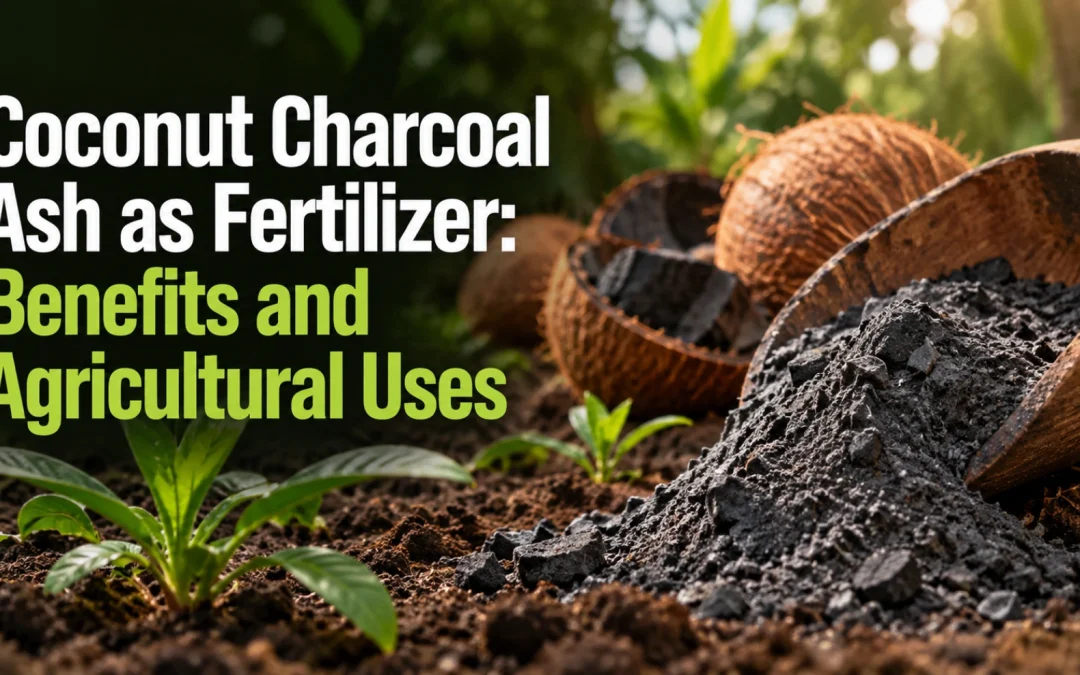
Coconut charcoal ash as fertilizer is gaining attention as a mineral-rich material that can be used in agricultural soil management. Produced after coconut-based charcoal is combusted, the remaining ash contains inorganic minerals that may contribute to soil fertility, particularly potassium, calcium, magnesium, and other mineral elements. Its alkaline characteristics can also make it relevant for managing soil acidity.
For importers, distributors, and trading companies in Europe, the Middle East, and North America, coconut charcoal ash can represent another potential coconut-derived material for agricultural and soil amendment markets. However, its composition can vary depending on the coconut material used, combustion conditions, and processing method. Therefore, quality specifications and laboratory analysis are important before using coconut charcoal ash as fertilizer for commercial agricultural applications.
Contents
- What Is Coconut Charcoal Ash?
- How Does Coconut Charcoal Ash Work as Fertilizer?
- 1. Provides Potassium
- 2. Supplies Calcium and Other Minerals
- 3. Helps Manage Acidic Soil
- Benefits of Coconut Charcoal Ash as Fertilizer
- Mineral-Based Nutrient Source
- Potential Soil pH Amendment
- Coconut Waste Valorization
- Suitable for Bulk Agricultural Markets
- Coconut Charcoal Ash vs. Coconut Charcoal and Biochar
- Factors to Consider When Buying Coconut Charcoal Ash
- Is Coconut Charcoal Ash Suitable for All Plants?
- Why Choose Coconut-Derived Agricultural Materials from Indonesia?
- FAQ
- 1. Can coconut charcoal ash be used as fertilizer?
- 2. Is coconut charcoal ash the same as biochar?
- 3. Does coconut charcoal ash increase soil pH?
- 4. What nutrients are found in coconut charcoal ash?
- 5. Can coconut charcoal ash replace conventional fertilizer?
What Is Coconut Charcoal Ash?
Coconut charcoal ash is the mineral residue left after coconut-based charcoal is burned under conditions that result in the removal of most combustible carbon. Depending on the production process, the raw material may come from coconut shells or other coconut biomass. It is important to distinguish coconut charcoal ash from coconut charcoal and biochar. Coconut charcoal is a carbon-rich material commonly used as fuel, while biochar is produced under controlled thermal conditions with the intention of retaining a substantial amount of stable carbon. Ash is different because it primarily contains inorganic mineral residues after combustion.
The mineral composition of coconut-derived ash depends on the original feedstock and production conditions. Research on coconut-based materials has identified minerals such as potassium, calcium, magnesium, phosphorus, and other elements in coconut shell and husk-derived products. This mineral content is one of the main reasons coconut charcoal ash as fertilizer is being considered for agricultural soil applications.
How Does Coconut Charcoal Ash Work as Fertilizer?
The potential agricultural value of coconut charcoal ash comes mainly from its mineral content and alkaline nature. Unlike nitrogen-rich organic fertilizers, ash should generally be considered a source of certain mineral nutrients and a soil amendment rather than a complete fertilizer.
1. Provides Potassium
Potassium is one of the most important nutrients associated with coconut-derived ash. It plays a role in several plant processes, including water regulation, enzyme activity, and overall plant development. A study published in Experimental Agriculture found that coconut husk ash could provide potassium effectively for immature coconut hybrids grown on peat soil. The research reported that coconut husk ash performed comparably to potassium chloride in the tested application context.
More recent research on king coconut husk ash has likewise reported relatively high total and available potassium compared with the corresponding biochar. Because potassium concentration can vary considerably between ash products, buyers should request laboratory specifications rather than relying on general nutrient assumptions.
2. Supplies Calcium and Other Minerals
Coconut-derived ash can also contain calcium, magnesium, phosphorus, and other mineral elements. A review of coconut shell and coconut husk biochar and related materials found that coconut-derived products contain a range of essential minerals, although their concentrations and availability vary according to processing conditions.
Calcium is particularly relevant to soil structure and plant development, while magnesium is an essential component of chlorophyll. However, coconut charcoal ash should not automatically be treated as a complete source of all nutrients required by crops. For commercial agricultural applications, it may be used as part of a broader soil fertility program based on soil testing and crop nutrient requirements.
3. Helps Manage Acidic Soil
Another potential use of coconut charcoal ash as fertilizer is soil pH management. Ash is generally alkaline, meaning it can increase soil pH when incorporated into acidic soils.
Research published in the Malaysian Journal of Chemistry investigated coconut shell ash for agricultural soil and found that its application increased the pH of acidic soil. The researchers identified its potential as an alternative liming material under the tested conditions. However, this characteristic also means that excessive application may raise soil pH beyond the desired range. The correct application rate therefore depends on the initial soil pH, soil characteristics, crop requirements, and the chemical properties of the ash.
Benefits of Coconut Charcoal Ash as Fertilizer
When properly characterized and applied, coconut charcoal ash may offer several advantages for agricultural soil management.
Mineral-Based Nutrient Source
The presence of potassium, calcium, magnesium, phosphorus, and other minerals can make coconut ash relevant as a supplementary mineral input. The exact nutrient profile should always be confirmed through laboratory testing.
Potential Soil pH Amendment
Because coconut ash is alkaline, it can help neutralize acidity in suitable soils. This may be particularly relevant for agricultural land where low soil pH limits nutrient availability.
Coconut Waste Valorization
Using coconut-derived ash creates an additional application for residues generated by the coconut processing and charcoal industries. Instead of treating all residual material as waste, selected ash streams can potentially be processed and supplied for agricultural applications.
Suitable for Bulk Agricultural Markets
For international buyers, coconut charcoal ash may be relevant to businesses involved in agricultural inputs, soil amendments, fertilizer blending, and coconut plantation management. Its suitability for export depends on product specifications, local regulations, packaging, and import requirements in the destination market.
Coconut Charcoal Ash vs. Coconut Charcoal and Biochar
Although these materials originate from similar feedstocks, they should not be treated as interchangeable. Coconut charcoal contains a high proportion of carbon and is commonly manufactured for applications such as fuel. Biochar is a carbon-rich material designed for soil and environmental applications and can have properties such as high surface area, water-holding capacity, and cation exchange capacity.
Coconut charcoal ash, on the other hand, is primarily the inorganic residue remaining after combustion. Its agricultural value is more closely associated with mineral content and alkalinity. This distinction is important for importers and distributors because each material has different specifications, applications, storage requirements, and potential regulatory classifications.
Factors to Consider When Buying Coconut Charcoal Ash
For international wholesale buyers, product quality should be evaluated based on measurable specifications rather than appearance alone.
Important factors may include:
- Potassium, calcium, magnesium, and phosphorus content
- Moisture content
- Ash content
- pH value
- Electrical conductivity
- Particle size
- Presence of unwanted contaminants
- Feedstock origin
- Production and combustion process
- Packaging and bulk handling requirements
- Laboratory test results and applicable documentation
Electrical conductivity is particularly relevant because excessive soluble salts can negatively affect plant growth. Research on coconut husk ash has highlighted the importance of both pH and EC when evaluating ash as a fertilizer or nutrient supplement. For buyers in Europe, the Middle East, and North America, import requirements and permitted agricultural uses should also be checked in the destination market before commercial distribution.
Is Coconut Charcoal Ash Suitable for All Plants?
No. Coconut charcoal ash should not automatically be applied to every crop or soil type. Its alkaline nature means it may be more relevant for acidic soils than already alkaline soils. Excessive application can increase soil pH and potentially affect nutrient availability. Similar concerns are recognized for other types of agricultural ash, where overapplication can cause excessive alkalinity and negatively affect plants.
The most appropriate application should therefore be determined based on soil analysis, crop requirements, and the chemical specifications of the ash. For commercial users, combining coconut charcoal ash with other fertilizers or soil amendments may also be considered when a broader nutrient profile is required. Research involving coconut-derived materials has investigated their use alongside conventional fertilizers and other soil amendments, rather than treating them as a universal replacement for fertilizer programs.
Why Choose Coconut-Derived Agricultural Materials from Indonesia?
Indonesia has an extensive coconut industry, creating significant potential for the processing and export of coconut-derived materials. Coconut shells and other coconut residues can be converted into products with applications across fuel, agriculture, horticulture, and industrial markets.
For international buyers, working with an experienced Indonesian supplier can help simplify sourcing by providing access to coconut-derived products according to commercial specifications. Magnus Java supplies coconut-based products for international markets and can support buyers looking for Indonesian coconut-derived materials for wholesale and trading purposes.
Explore cocofiber and other products from Magnus Java to discover more coconut-derived products for international markets.
Visit our social media:
- Instagram: @Magnusjava
- Facebook: @Magnusjava
- LinkedIn: @Magnusjava
Follow Magnus Java and discover more about Indonesian coconut charcoal for hookah, shisha, and international wholesale markets.
FAQ
1. Can coconut charcoal ash be used as fertilizer?
Yes, coconut charcoal ash can potentially be used as a mineral fertilizer or soil amendment because it may contain potassium, calcium, magnesium, phosphorus, and other minerals. Its suitability depends on its chemical composition and the requirements of the soil and crop.
2. Is coconut charcoal ash the same as biochar?
No. Coconut charcoal ash is primarily the mineral residue produced after combustion, while biochar is a carbon-rich material produced through controlled thermal processing. Their properties and agricultural applications are different.
3. Does coconut charcoal ash increase soil pH?
Yes. Coconut-derived ash is generally alkaline and can increase the pH of acidic soil. Research on coconut shell ash has demonstrated its potential to reduce soil acidity.
4. What nutrients are found in coconut charcoal ash?
The exact composition varies, but coconut-derived ash can contain potassium, calcium, magnesium, phosphorus, and other mineral elements. Laboratory analysis should be used to determine the actual nutrient concentration of a specific product.
5. Can coconut charcoal ash replace conventional fertilizer?
Not necessarily. Coconut charcoal ash can provide certain minerals and may help manage soil acidity, but it should not automatically be considered a complete replacement for conventional fertilizers. Crop nutrient requirements and soil test results should guide the overall fertilizer program.