
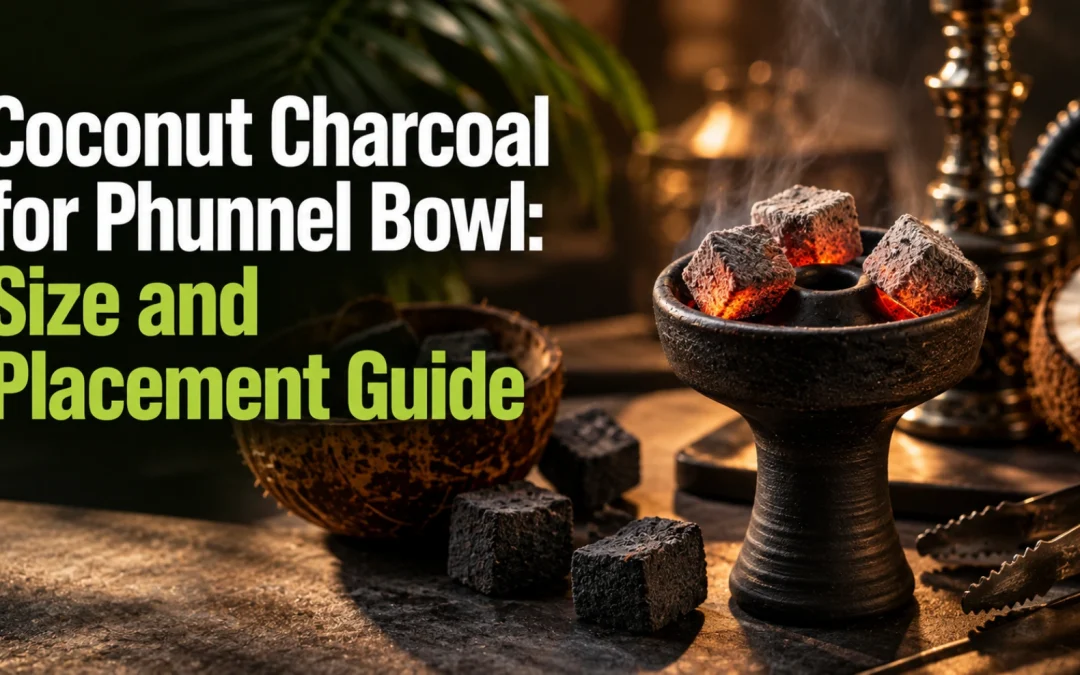
Choosing the right coconut charcoal for phunnel bowl setups can affect heat distribution, session consistency, and overall shisha performance. Unlike traditional bowls with a central hole, a phunnel bowl features a raised center that keeps shisha juices from flowing directly into the stem. This design also influences how heat should be distributed across the bowl.
For importers, distributors, and trading companies sourcing coconut charcoal for phunnel bowl applications, understanding charcoal dimensions and placement is important when evaluating products for different international markets. Cube size, heat output, ash characteristics, and consistency can all influence how the charcoal performs across different phunnel bowl sizes and heat management setups.
Contents
- What Is a Phunnel Bowl?
- Why Use Coconut Charcoal for Phunnel Bowl?
- 1. Consistent Heat Output
- 2. Suitable Cube Options
- 3. Low-Ash Performance
- 4. Reliable Burning Characteristics
- What Size Coconut Charcoal for Phunnel Bowl?
- How to Place Coconut Charcoal on a Phunnel Bowl
- Two-Charcoal Setup
- Three-Charcoal Setup
- Avoid Placing Charcoal Directly in the Center
- How to Manage Heat With Coconut Charcoal
- Coconut Charcoal for Phunnel Bowl: What Should Importers Check?
- Why Source Coconut Charcoal From Indonesia?
- How to Choose a Coconut Charcoal Supplier
- FAQ
- 1. What size coconut charcoal is best for a phunnel bowl?
- 2. How many coconut coals should I use on a phunnel bowl?
- 3. Where should coconut charcoal be placed on a phunnel bowl?
- 4. Can 26 mm coconut charcoal be used for a phunnel bowl?
- 5. What should wholesalers check when buying coconut charcoal?
What Is a Phunnel Bowl?
A phunnel bowl is a type of hookah or shisha bowl characterized by a raised central spire or opening. Unlike an Egyptian-style bowl, where airflow holes are distributed across the bottom, the phunnel design generally keeps the shisha mixture around the central spire. This structure can help retain molasses and flavoring inside the bowl rather than allowing them to drain through the stem. The design also makes heat distribution particularly important because the charcoal is generally positioned around the outer area rather than directly over the center.
When using coconut charcoal for phunnel bowl setups, the objective is usually to distribute heat gradually across the shisha instead of creating one concentrated hot spot. According to Hookah.org, charcoal placement around the edge of the bowl allows the bowl to heat more gradually and evenly, while starting charcoal in the center can increase the risk of scorching.
Why Use Coconut Charcoal for Phunnel Bowl?
Natural coconut shell charcoal is widely used for hookah and shisha because it can provide a relatively consistent heat source when properly manufactured and prepared. For commercial buyers, several characteristics are particularly relevant when sourcing coconut charcoal for phunnel bowl applications.
1. Consistent Heat Output
Consistent charcoal dimensions can help make heat management more predictable. If cube dimensions vary significantly within the same batch, individual pieces may deliver different amounts of heat. For distributors and importers, dimensional consistency is therefore an important specification when comparing coconut charcoal cubes from different suppliers.
2. Suitable Cube Options
Coconut charcoal is commonly manufactured in different cube dimensions, including approximately 22 mm, 25 mm, and 26 mm formats. Some manufacturers also offer larger or customized dimensions depending on buyer requirements. A 25 mm cube is frequently used for hookah applications, while smaller cubes can be useful for smaller bowls or situations where lower heat input is preferred. Commercial manufacturers may also offer custom sizes for specific customer requirements.
3. Low-Ash Performance
Ash content is another specification buyers should evaluate. Excessive ash can interfere with heat transfer and requires more frequent cleaning or coal management during a session. For wholesale sourcing, buyers should request technical specifications and quality documentation rather than judging charcoal quality solely by appearance.
4. Reliable Burning Characteristics
A well-manufactured coconut shell charcoal briquette should maintain useful heat during the session without excessive breakage. For international distribution, this becomes particularly relevant because the product may experience handling and transportation before reaching its final customer.
What Size Coconut Charcoal for Phunnel Bowl?
The appropriate coconut charcoal for phunnel bowl depends on the bowl diameter, tobacco quantity, heat management device, and desired heat level. As a general commercial reference, 22–25 mm cubes can cover many common phunnel bowl applications, while 25 mm cubes are widely used as a standard hookah charcoal format. Some setups also use 26 mm cubes when higher heat capacity is required.
A practical starting reference is:
- 22 mm cubes: suitable for smaller phunnel bowls or lower heat requirements
- 25 mm cubes: common all-purpose size for standard phunnel setups
- 26 mm cubes: can provide greater heat capacity for larger setups
- Custom sizes: useful for distributors serving specific bowl or HMD requirements
There is no universal charcoal size that works identically for every phunnel bowl. A smaller bowl may become overheated when paired with several large cubes, while a larger bowl may require more heat to reach the desired temperature.
Some current industry guides recommend three 25 mm cubes for phunnel bowls, while smaller bowls may use smaller cubes or fewer pieces. Therefore, buyers should treat these figures as starting points rather than fixed specifications.
How to Place Coconut Charcoal on a Phunnel Bowl
Proper placement is one of the most important parts of using coconut charcoal for phunnel bowl setups. The basic principle is to distribute the charcoal around the outer perimeter while keeping the central spire relatively clear.
Two-Charcoal Setup
With two pieces, place the cubes on opposite sides of the bowl. This arrangement creates two primary heat zones and leaves the center free from direct charcoal contact. It can be useful when working with a smaller bowl or a shisha mixture that does not require a high initial heat load.
Three-Charcoal Setup
For three pieces, position the charcoal in a triangle around the outer edge. The pieces should be spaced relatively evenly rather than stacked together. This helps distribute heat across different areas of the bowl. Hookah similarly recommends positioning coals around the outside of a phunnel bowl and using two to three pieces depending on bowl size and heat preference.
Avoid Placing Charcoal Directly in the Center
One common mistake is placing coconut charcoal for phunnel bowl directly over the center. The center of a phunnel bowl contains the raised spire, while the shisha is distributed around it. Placing charcoal too close to the center can concentrate heat in one area and potentially produce a harsh or overheated session. Starting charcoal toward the edge allows heat to move inward more gradually. Hookah.org also recommends starting charcoal at the edge and moving it inward only as needed.
How to Manage Heat With Coconut Charcoal
Even the right coconut charcoal for phunnel bowl can perform poorly if heat is not managed correctly. Before placing the charcoal on the bowl, make sure the pieces are fully ignited. Natural coconut charcoal should generally be heated until the exterior is glowing and sufficiently ashed before use.
Once placed on the bowl, allow the setup to heat gradually rather than immediately adding more charcoal. If the smoke becomes harsh or the flavor changes noticeably, reducing the heat may be more appropriate than adding additional charcoal.
As the charcoal becomes smaller, its position can also be adjusted toward the center to maintain heat coverage. Regularly rotating or repositioning the pieces can help compensate for changes in their heat-producing surface. For commercial users, these characteristics make consistent coconut charcoal dimensions particularly important. Uniform cubes make heat-management instructions easier to standardize across different sessions and customers.
Coconut Charcoal for Phunnel Bowl: What Should Importers Check?
For importers and distributors in Europe, Middle East, and North America, selecting coconut charcoal for phunnel bowl applications requires more than checking the cube size.
Before placing a wholesale order, consider the following specifications:
- Charcoal dimensions: Confirm whether the supplier offers 22 mm, 25 mm, 26 mm, or customized sizes.
- Ash content: Request the supplier’s stated ash specification and testing information.
- Moisture: Excess moisture can affect storage and ignition performance.
- Fixed carbon: This can help buyers evaluate the fuel characteristics of the product.
- Burning time: Compare the stated performance under clearly defined testing conditions.
- Density and durability: Charcoal should withstand normal handling and transportation.
- Odor and smoke: Product characteristics should be consistent with the intended hookah or shisha market.
- Packaging: Confirm carton, inner box, private-label, and bulk packaging options.
- Production capacity: Important for distributors and trading companies managing recurring orders.
- Quality control: Ask whether the supplier performs batch-level inspection and maintains product specifications.
Specifications should always be verified directly with the manufacturer because performance can vary according to raw materials, production methods, formulation, dimensions, and testing conditions.
Why Source Coconut Charcoal From Indonesia?
Indonesia has an established coconut-processing industry, making coconut shell charcoal an important value-added derivative of coconut resources. For international buyers, Indonesian suppliers can provide coconut shell charcoal in different shapes and specifications, including cube formats commonly used for hookah and shisha applications.
For coconut charcoal for phunnel bowl, buyers can also discuss specifications according to their target market, packaging requirements, and distribution model. This is particularly relevant for trading companies and distributors that may need consistent specifications across recurring shipments. For businesses looking for Indonesian coconut-derived products, Magnus Java supplies coconut charcoal products for international markets and can support commercial sourcing requirements.
How to Choose a Coconut Charcoal Supplier
When sourcing coconut charcoal for phunnel bowl at wholesale scale, supplier evaluation should focus on consistency rather than a single product specification. A supplier that can maintain consistent cube dimensions, moisture, ash characteristics, packaging, and production quality can make it easier for importers and distributors to maintain the same product experience across multiple shipments.
It is also useful to request samples before committing to a larger order. Testing the charcoal with the phunnel bowls and heat management systems used by your customers can provide more practical information than specifications alone. For buyers serving Europe, Middle East, and North America, it is also worth discussing packaging, private labeling, shipping terms, documentation, minimum order quantities, and production capacity before finalizing a wholesale agreement. Explore cocofiber and other products from Magnus Java.
Visit our social media:
Instagram: @Magnusjava
Facebook: @Magnusjava
LinkedIn: @Magnusjava
FAQ
1. What size coconut charcoal is best for a phunnel bowl?
A 25 mm cube is a common starting point for many phunnel bowl setups. However, 22 mm or 26 mm cubes may be more appropriate depending on bowl size, heat management equipment, and the desired heat level.
2. How many coconut coals should I use on a phunnel bowl?
Many setups begin with two or three natural coconut charcoal cubes. The exact quantity depends on bowl size, charcoal dimensions, shisha type, and heat management method. Starting with less heat and adjusting gradually can help prevent overheating.
3. Where should coconut charcoal be placed on a phunnel bowl?
Place the charcoal around the outer edge of the bowl rather than directly over the center. With three pieces, an evenly spaced triangular arrangement is commonly used to distribute heat.
4. Can 26 mm coconut charcoal be used for a phunnel bowl?
Yes. 26 mm coconut charcoal can be used for phunnel bowls, but the appropriate number of pieces depends on the bowl and heat management setup. Because larger cubes can deliver more heat, users may need fewer pieces or more careful heat adjustment.
5. What should wholesalers check when buying coconut charcoal?
Importers and distributors should evaluate dimensions, ash content, moisture, fixed carbon, burning characteristics, durability, packaging, quality control, production capacity, and documentation. Samples and batch specifications should also be reviewed before placing recurring wholesale orders.