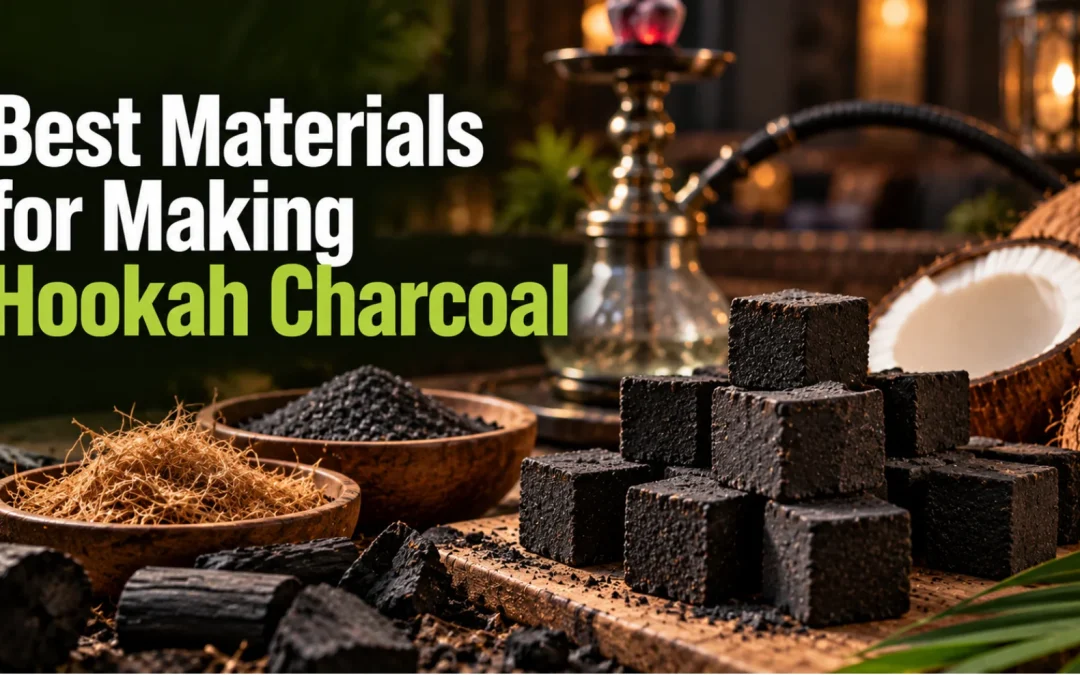
Choosing the best material for hookah charcoal is essential for manufacturers, importers, distributors, and trading companies serving the international shisha market. The raw material influences important product characteristics, including burning time, heat consistency, ash production, odor, and briquette durability. Coconut shells and wood are commonly used for charcoal production, but their performance depends on the manufacturing process and the specifications of the finished product.
For businesses operating across Europe, the Middle East, and North America, understanding the best material for hookah charcoal can support more informed sourcing decisions. Buyers need to evaluate not only the raw material but also carbon content, moisture levels, packaging, production consistency, and export capabilities. These factors help importers identify products that meet customer expectations and support reliable long-term wholesale supply.
Contents
- What Is the Best Material for Hookah Charcoal?
- 4 Best Materials for Making Hookah Charcoal
- 1. Coconut shells
- 2. Hardwood
- 3. Other wood-based biomass
- 4. Mixed biomass materials
- Coconut Shell Charcoal vs. Wood Charcoal for Shisha
- Factors That Determine Hookah Charcoal Quality
- Fixed carbon and ash content
- Moisture content
- Density and mechanical strength
- Binder selection and production control
- How to Choose a Hookah Charcoal Supplier for International Markets
- Why Consider Indonesian Coconut Shell Charcoal?
- FAQ
- 1. What is the best material for hookah charcoal?
- 2. Is coconut shell charcoal better than wood charcoal for shisha?
- 3. What should importers check when buying hookah charcoal?
- 4. Why is low-ash charcoal important for hookah?
- 5. Can coconut shell charcoal be purchased in bulk?
What Is the Best Material for Hookah Charcoal?
The best material for hookah charcoal depends on the intended application, manufacturing process, and quality requirements. Coconut shells are a popular choice for producing coconut shell charcoal because they are a byproduct of coconut processing and can be converted into charcoal through controlled carbonization. Hardwood and other wood-based materials are also used, depending on local resources and production practices.
For premium shisha products, coconut shell charcoal is often preferred because properly manufactured briquettes can provide consistent heat and relatively low ash content. However, these characteristics are not guaranteed by the raw material alone. Carbonization temperature, binder selection, compression, drying, and quality control all influence the final product. For international buyers, comparing raw materials alongside verified product specifications is more useful than assuming that one material automatically delivers superior performance.
4 Best Materials for Making Hookah Charcoal
Several materials can be used to produce charcoal, but their suitability depends on availability, processing requirements, and the desired characteristics of the finished product. Understanding these differences can help buyers determine the best material for hookah charcoal for their target markets.
1. Coconut shells
Coconut shells are a widely recognized raw material for coconut shell charcoal. The shells are separated from the coconut’s edible components and processed through carbonization, which converts the biomass into charcoal under controlled oxygen conditions. This material is particularly relevant for manufacturers producing coconut charcoal briquettes for hookah and shisha applications.
Key characteristics include:
- Potentially high fixed carbon: Properly carbonized coconut shells can produce charcoal with high fixed-carbon content, depending on processing conditions.
- Dense charcoal structure: The resulting charcoal can support consistent heat output when briquettes are manufactured correctly.
- Agricultural byproduct utilization: Coconut shells provide a commercial use for material generated during coconut processing.
- Flexible product formats: Coconut shell charcoal can be processed into different briquette shapes and sizes according to buyer requirements.
For importers and distributors, coconut shell charcoal is an option for businesses seeking natural hookah charcoal with defined quality specifications. Buyers should still verify fixed carbon, ash content, moisture, odor, and burning performance through product documentation or testing.
2. Hardwood
Hardwood is another traditional raw material for charcoal production. Depending on the wood species and manufacturing process, hardwood charcoal can provide useful heat output and suitable burning performance.
Its characteristics vary according to wood density, moisture content, carbonization conditions, and the presence of bark or other impurities. Hardwood charcoal may also require additional processing to achieve the particle size and consistency needed for briquette manufacturing. For hookah applications, buyers should evaluate whether the finished product meets requirements for odor, ash content, heat stability, and intended use. General-purpose barbecue charcoal should not automatically be considered suitable for hookah use.
3. Other wood-based biomass
Other wood-based biomass materials can be converted into charcoal, depending on their availability and suitability for the production process. These materials may offer sourcing flexibility for manufacturers in regions with established forestry or agricultural industries.
However, their performance can differ from coconut shell charcoal. Feedstock composition, contamination, carbonization efficiency, and the resulting charcoal structure all affect product quality. For international wholesale buyers, the important consideration is whether the supplier can provide consistent specifications and demonstrate that the finished charcoal is appropriate for hookah applications.
4. Mixed biomass materials
Some manufacturers use combinations of biomass-derived charcoal materials to manage raw material availability, production costs, or product characteristics. These formulations may be suitable for certain applications, but their quality depends on the composition and processing controls.
Mixed materials require attention to traceability and consistency. Variations in feedstock can affect burning behavior, ash production, odor, and briquette strength. Importers should request detailed product specifications and clarify the composition of the charcoal before placing large wholesale orders.
Coconut Shell Charcoal vs. Wood Charcoal for Shisha
Understanding the differences between coconut shell charcoal and wood charcoal helps buyers select products that align with customer expectations.
Coconut shell charcoal is often selected for premium hookah applications because properly manufactured briquettes can provide consistent heat and relatively low ash. It also makes use of coconut processing byproducts, which can be an advantage for businesses interested in agricultural resource utilization. Wood charcoal offers a broad range of characteristics depending on the wood species and production method. Its quality can vary considerably, making supplier specifications especially important.
When comparing these materials, importers and distributors should evaluate several factors:
- Burning time: Determine how long the charcoal maintains useful heat under standardized testing conditions.
- Heat consistency: Check whether the briquettes provide stable heat without excessive fluctuations.
- Ash content: Lower ash content may reduce residue during use, but actual results depend on the finished product.
- Odor and smoke: Assess whether the charcoal produces unwanted odors or excessive smoke during ignition and use.
- Durability: Check whether the briquettes resist breakage during handling, storage, and transportation.
- Price and supply continuity: Compare total landed cost, minimum order quantities, and the supplier’s ability to maintain consistent shipments.
No single raw material guarantees the best results in every category. The most suitable choice depends on quality standards, intended markets, and commercial requirements.
Factors That Determine Hookah Charcoal Quality
Even when manufacturers select the best material for hookah charcoal, the production process determines whether the finished product meets market expectations. Importers should understand several quality indicators before choosing a supplier.
Fixed carbon and ash content
Fixed carbon indicates the proportion of carbon remaining after volatile components are accounted for using the relevant analytical method. It helps buyers assess charcoal composition alongside other test results. Ash content measures the inorganic residue remaining after combustion. Excessive ash may affect product cleanliness and user experience. Buyers should request laboratory results and confirm the testing methods used rather than relying solely on marketing claims.
Moisture content
Moisture influences storage stability, ignition, and burning behavior. Charcoal briquettes with excessive moisture may be more difficult to ignite and may perform inconsistently. For wholesale shipments, moisture specifications should be agreed upon before production and verified through appropriate sampling.
Density and mechanical strength
Briquette density and strength affect heat performance and resistance to physical damage. Fragile charcoal can generate broken pieces and dust, potentially increasing losses during shipping and distribution. Manufacturers should maintain consistent compression and drying processes to help ensure that finished briquettes retain their shape.
Binder selection and production control
Powdered charcoal may require a binder to form durable briquettes. The binder, its proportion, and the manufacturing process can influence the final product’s burning characteristics and strength. Buyers should confirm the product composition and ensure that any binder is suitable for its intended application. Quality claims should be supported by appropriate documentation and testing.
How to Choose a Hookah Charcoal Supplier for International Markets
Importers, distributors, and trading companies need more than suitable raw materials. They also need suppliers capable of meeting commercial specifications and supporting reliable international shipments.
When evaluating a hookah charcoal supplier, consider these practical steps:
- Request a complete specification sheet. Review fixed carbon, ash content, moisture, volatile matter, dimensions, and other relevant product parameters.
- Evaluate samples before ordering. Test ignition behavior, burning consistency, odor, ash production, and durability under comparable conditions.
- Confirm packaging requirements. Packaging should protect briquettes from moisture and physical damage during handling and transportation.
- Review production capacity. Ensure the supplier can accommodate expected order volumes and repeat shipments.
- Check export documentation. Confirm the availability of relevant shipping documents, product information, and destination-specific compliance requirements.
- Discuss customization and minimum orders. Clarify briquette shapes, sizes, packaging formats, branding options, and minimum order quantities before finalizing a purchase.
Requirements may differ across Europe, the Middle East, and North America. Importers should verify applicable product safety, labeling, customs, and transportation requirements in each destination rather than assuming that the same documentation is sufficient for every market.
Why Consider Indonesian Coconut Shell Charcoal?
Indonesia has an established coconut industry, creating opportunities to utilize coconut processing byproducts for commercial applications. Coconut shells can be converted into charcoal and processed into briquettes for various markets, including hookah and shisha. For international buyers, sourcing Indonesian coconut shell charcoal can provide access to a supply chain built around coconut-derived materials. However, buyers should assess each supplier based on verified product specifications, production consistency, export experience, and order requirements.
Magnus Java offers coconut-derived products for businesses exploring Indonesian raw materials and charcoal-related products. Importers, distributors, and trading companies can review its product range to identify options that align with their sourcing needs.
Explore cocofiber and other products from Magnus Java: Visit the Magnus Java product catalog.
Visit our social media:
Instagram: @Magnusjava
Facebook: @Magnusjava
LinkedIn: @Magnusjava
FAQ
1. What is the best material for hookah charcoal?
Coconut shells are a popular choice because properly processed coconut shell charcoal can offer consistent heat, relatively low ash, and useful burning performance. However, the final quality depends on manufacturing methods and quality control.
2. Is coconut shell charcoal better than wood charcoal for shisha?
Coconut shell charcoal is often preferred for premium shisha applications because of its potential for consistent performance and relatively low ash content. Wood charcoal can also be suitable if it meets the required specifications for hookah use.
3. What should importers check when buying hookah charcoal?
Importers should review fixed carbon, ash content, moisture, odor, burning time, briquette strength, packaging, and export documentation. Testing samples before placing bulk orders can help verify whether the product meets their requirements.
4. Why is low-ash charcoal important for hookah?
Lower ash content can reduce the residue left after combustion and may contribute to a cleaner user experience. Buyers should also assess heat consistency, ignition behavior, odor, and other performance characteristics.
5. Can coconut shell charcoal be purchased in bulk?
Yes. Coconut shell charcoal and coconut charcoal briquettes are traded internationally in bulk, subject to supplier capacity, product specifications, packaging, and minimum order quantities. Importers should confirm these details directly with the supplier before placing an order.