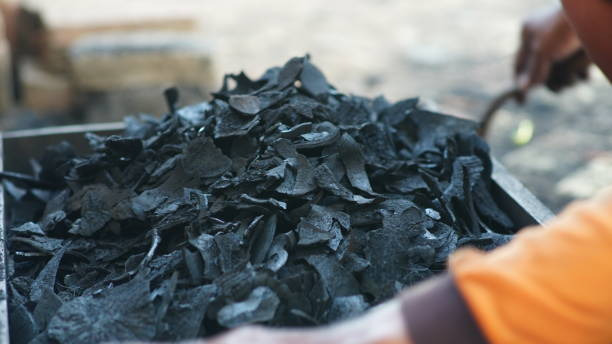
Renewable energy coconut shell charcoal has become a primary focus amidst the urgent global need for new and renewable energy, where utilizing industrial waste is a key strategy for reducing carbon emissions. One innovation currently capturing the attention of the scientific and industrial worlds is the conversion of coconut shells into charcoal briquettes. By combining the geographical potential of coastal regions with the superior physicochemical characteristics of the material, this organic resource has proven capable of producing green energy that is efficient, economical, and sustainable to replace fossil fuels.
Contents
- 1. The Global Energy Crisis and the Real Impact of Fossil Fuels
- 2. Abundant Geographical Potential and Industrial Waste Optimization
- 3. The Superior Physicochemical Characteristics of Coconut Shells
- 4. Thermal Kinetics Analysis for Production Efficiency
- 5. Mechanical and Financial Advantages of Coconut Shell Charcoal Briquettes
- References
- Frequently Asked Questions (FAQ)
- 1. What makes coconut shell charcoal briquettes superior to regular wood charcoal?
- 2. Are these briquettes suitable for heavy industrial applications?
- 3. Why is renewable energy coconut shell charcoal gaining so much momentum in global markets?
1. The Global Energy Crisis and the Real Impact of Fossil Fuels
The global reliance on fossil fuels poses a double threat: the rapid depletion of finite natural resources and severe environmental degradation. Continuous consumption of fossil fuels releases massive amounts of greenhouse gases into the atmosphere, primarily carbon dioxide (CO2), which drives global warming and extreme climate change.
Beyond carbon dioxide, burning fossil fuels releases hazardous pollutants such as sulfur dioxide (SO2) and nitrogen dioxide (NO2). These gases trigger acid rain, which causes widespread damage to Earth’s ecosystems. The adverse effects include a drastic decline in water quality, depletion of soil nutrients, the extinction of acid sensitive plant and animal species, and chronic respiratory diseases in humans. Converting organic waste into sustainable biomass is an absolute necessity to break this cycle of environmental destruction.
2. Abundant Geographical Potential and Industrial Waste Optimization
Unlike coal, which takes millions of years to form, coconut biomass offers an incredibly rapid energy renewal cycle. Indonesia holds a strategic position and an extraordinary geographical advantage in supplying this raw material:
-
Indonesia is a massive archipelagic nation with approximately 17,000 islands and a marine area spanning 5.8 million square kilometers—accounting for about 71 percent of the total national territory.
-
It possesses the second longest coastline in the world, stretching 95,181 kilometers, where coconut trees thrive abundantly across almost all coastal regions.
This geographical factor makes Indonesia one of the largest coconut producers in the world. Unfortunately, large volumes of coconut shell waste from major processing industries (such as coconut milk and copra factories) are often underutilized and end up as landfill waste. Transforming coconut shells into charcoal briquettes not only reduces landfill volume but also turns a cheap byproduct into a high value green energy commodity.
3. The Superior Physicochemical Characteristics of Coconut Shells
Based on standardized thermal laboratory analysis, coconut shells exhibit superior physicochemical parameters compared to other commercial solid biomass materials:
-
Coconut shells contain a volatile matter content of 77.38 percent by weight (wt%). This is significantly higher than other commercial biomass sources like wood chips (68.60 wt%) and rice husks (70.33 wt%). This high volatile content is ideal for maximizing bio oil yield through flash pyrolysis.
-
Analysis shows that the ash content of coconut shells is only 0.31 wt%. This exceptionally low ash content is a crucial quality indicator, as high ash accumulation in combustion systems risks causing slagging, fouling, solid agglomeration, and a reduction in heat transfer efficiency within conversion machinery.
-
The fixed carbon content is recorded at 22.31 wt%. Elemental testing reveals a carbon content of 49.42 wt%, oxygen at 42.86 wt%, and hydrogen at 5.96 wt%. The most eco friendly aspect is the remarkably low levels of nitrogen (0.96 wt%) and sulfur (0.49 wt%). These minimal pollutant precursors ensure that emissions of sulfur oxides (SOx) and nitrogen oxides (NOx) released into the atmosphere remain at a safe level.
-
Coconut shells deliver a Higher Heating Value (HHV) of 19.87 Megajoules per kilogram (MJ/kg) and a Lower Heating Value (LHV) of 18.66 MJ/kg. This thermal power surpasses average popular biomass fuels such as wood sawdust (18.02 MJ/kg), wood chips (15.16 MJ/kg), rice husks (15.90 MJ/kg), and barley straw (17.37 MJ/kg).
-
The initial bulk density of this material reaches 764.74 kilograms per cubic meter (kg/m3). This high natural density is comparable to manufactured biomass fuels that have been artificially densified, such as commercial pellets (which range between 350 and 750 kg/m3). This high density is a major advantage for producers because it slashes logistics, transport, and storage costs across the supply chain.
4. Thermal Kinetics Analysis for Production Efficiency
To efficiently convert coconut shells into high quality charcoal via pyrolysis (decomposition in the absence of oxygen), engineers rely on the kinetic parameters of its three main polymer components. Testing using symmetric Gaussian function deconvolution yields the following average Activation Energy (Ea) values:
-
The hemicellulose component decomposes within an activation energy range of 124.2 to 133.5 kilojoules per mol (kJ/mol).
-
The cellulose component requires an activation energy range of 159.7 to 170.1 kJ/mol.
-
The more complex lignin structure decomposes within an activation energy range of 151.5 to 162.8 kJ/mol.
This kinetic data and thermodynamic parameters provide precise scientific guidelines for industries to optimize pyrolysis reactor designs, thereby minimizing the input energy required during the charcoal manufacturing process.
5. Mechanical and Financial Advantages of Coconut Shell Charcoal Briquettes
When processed into briquettes using natural binders (such as tapioca or starch), coconut shell charcoal delivers several practical and functional advantages:
-
Coconut shell charcoal briquettes produce virtually no smoke when burned, making them much cleaner and safer for respiratory health and environmental hygiene.
-
The thermal energy produced by the briquettes is intense, constant, and stable, significantly accelerating cooking times or industrial heating processes.
-
The molecular characteristics of coconut charcoal allow it to ignite and burn far longer than regular firewood or conventional charcoal, making it highly cost effective.
-
Burning biomass briquettes only releases the carbon that the coconut trees previously absorbed from the atmosphere through photosynthesis. Consequently, the emissions are carbon neutral and do not add new greenhouse gases to the planet.
-
Because raw coconut shell waste is cheap and locally abundant, utilizing it is far more economical than relying on petroleum based fuels. This fosters community level economic self sufficiency and reduces dependence on imported energy resources.
Ready to transition to a cleaner, more efficient, and highly sustainable energy solution? Magnus Java is your premier global partner and trusted supplier of top tier coconut shell charcoal briquettes. Sourced directly from the rich coastal regions of Indonesia and processed using advanced eco friendly pyrolysis, our briquettes guarantee an exceptionally high thermal output, consistent burning times, and zero harmful chemicals.
Whether you require premium fuel for commercial heating, specialized industrial applications, or gourmet culinary markets, Magnus Java delivers unparalleled quality that honors our planet.
Empower your business with the ultimate biomass alternative. Contact Magnus Java today to secure your premium sustainable energy supply!
References
-
Alves, J. L. F., da Silva, J. C. G., Mumbach, G. D., de Sena, R. F., Machado, R. A. F., & Marangoni, C. (2022). Prospection of catole coconut (Syagrus cearensis) as a new bioenergy feedstock: Insights from physicochemical characterization, pyrolysis kinetics, and thermodynamics parameters. Renewable Energy, 181, 207-218.
-
Putri, E. P. (2024). Renewable Energy: Charcoal Briquettes from Coconut Shells. Department of Industrial Engineering, Universitas 17 Agustus 1945 Surabaya.
Frequently Asked Questions (FAQ)
1. What makes coconut shell charcoal briquettes superior to regular wood charcoal?
Coconut shell briquettes burn significantly longer (up to 3 hours), produce intense and uniform heat, and leave behind almost zero ash residue (only 0.31 percent by weight). Unlike wood charcoal, they do not require cutting down forests and are completely smokeless and odorless.
2. Are these briquettes suitable for heavy industrial applications?
Yes. Boasting a high calorific value of 19.87 Megajoules per kilogram and a solid bulk density, they provide the persistent and robust heat matrix required for diverse commercial and industrial thermal setups.
3. Why is renewable energy coconut shell charcoal gaining so much momentum in global markets?
Global markets are heavily prioritizing carbon-neutral operations. Since this energy source relies completely on agricultural waste, it helps enterprises cut greenhouse gas emissions dramatically while fulfilling strict ESG (Environmental, Social, and Governance) targets without sacrificing thermal performance.